PROJECTS
YOU CAN SEE MORE INFORMATION ABOUT MY PROJECTS BY CHECKING MY LINKEDIN AND GITHUB ACCOUNTS:


FRENCH MATHEMATICS TUTORING FOR INTERNATIONAL STUDENTS
THE STORY BEHIND IT

When I arrived in France, I had a hard time dealing with a course called 'Analyse pour les Ingénieurs' (Analysis for Engineers). As an international student, I had a strong but very different mathematics background compared to the French students. The level of rigor, the requirement to prove every small concept, and the topics themselves were very challenging to adapt to. On top of that, the language difficulties at the beginning of my double-degree program didn’t help. Naturally, the number of international students failing the course each year (not only me), especially from Brazil, Chile, and Mexico, was tremendously high. The international department at Centrale Lille had already implemented numerous attempts to support us, but the problem persisted.
After studying intensively for months, I finally succeeded and passed the course with a very good score, which allowed me, together with the international department, to pursue a personal project: providing French mathematics tutoring sessions to international students. In addition, I created a YouTube channel to support foreign students who encounter French-style mathematics in their studies.
Among all the projects I have taken part in, this is the one I am most proud of. It pushed me to my limits, both academically and emotionally. Combining the challenges of the course with the distance from home, a new environment, a new culture, and the lack of sunlight during winter, it was the moment in my life when I had to be the most resilient. In the end, I learned a great deal about myself, about what I am capable of, and about how to add value to life experiences by helping others.
WHAT'S BEEN MADE

-
More than 50 hours of lecturing
-
More than 10 hours of video uploaded
-
More than 20 authentic exercises created
-
More than 30 pages of teaching ressources written
-
All that both in english and portuguese !
-
My pre-arrival guide, distributed by the university to future international double-degree students.
SKILLS


Measure theory
Lebsegue integral
Fourier series and transform
Distributions
ODEs
Video editing
Public speaking
Didactics
On-camera communication
Emotional intelligence
Empathy
Organization
FEEDBACK

Victor Hugo Paiva Mejia

"Rodrigo's tutoring is not just a complement, but also a foundation for all of my studies. It makes a huge difference to have exercises explained in my native language, especially when it comes from someone who truly masters the subject as much as he does."
Ana Lorena Benavente Pardo

"The tutoring sessions are very well thought out. Rodrigo takes the time to explain and to make sure that we have understood. In addition, he complements the in-person sessions with his YouTube videos. I am grateful for the time he takes to run these tutoring sessions every week and to help international students with the AIN class."

Iuri Rezende
"His tutoring helps me greatly to truly understand the subject while also knowing exactly what is necessary to perform well on exams and pass. Objective, patient, didactic, hardworking, disciplined, and responsible, Rodrigo represents the best one can expect from a student and a teaching assistant, even in a subject as challenging as Analyse pour l’ingénieur."
RESULTS
Supported 15 international students
Reached a 70% pass rate among new students
100% pass rate among students who took the mock exam
Improved historical pass rates from 20% to 67%
Helped reduce year repetition to 0 in the last two observed cohorts
Built a support structure continued by 3 students for future cohorts
THE PROCESS


CLICK TO VIEW THE CHANNEL:

BIOMIMETIC FLOW CONTROL PROJECT
This project was an applied aerodynamics challenge focused on reducing the aerodynamic drag of road vehicles through a combination of design, simulation, and experimentation. The goal was to minimize the drag of two 1:25 scale vehicle models, an SUV and a sedan, operating at around 16 m/s. Starting from a baseline geometry provided by the instructors, the task was not to redesign the entire car, but to improve its aerodynamic performance by adding and refining external components under strict geometric, weight, and mounting constraints.
The core of the work revolved around aerodynamic optimization and flow control. Different shape modifications and biomimetic-inspired solutions were explored, including passive devices and surface treatments aimed at reducing separation and wake losses. Each concept had to be justified from a physical point of view, tested or simulated, and either improved or discarded based on its actual impact on drag. This iterative process mirrored real engineering development, where performance, feasibility, and robustness must all be balanced.
To guide the design choices, the project combined numerical simulations and wind tunnel experiments. CFD simulations were carried out using RANS turbulence models to analyze the flow around the vehicle, identify high-drag regions, and compare different configurations before manufacturing. The most promising designs were then validated experimentally in a wind tunnel equipped with a high-precision aerodynamic balance, allowing direct measurement of drag and comparison with numerical predictions.
From a practical perspective, the project also involved extensive CAD work and rapid prototyping. Aerodynamic add-ons were designed in CAD and manufactured mainly through 3D printing, under tight time and resource constraints. This introduced realistic trade-offs between aerodynamic performance, manufacturing complexity, and weight, reinforcing the link between theoretical ideas and industrial feasibility.
Overall, this project provided hands-on experience with applied aerodynamics, CFD, and experimental validation. It closely resembled real-world engineering workflows, combining physics-based reasoning, numerical tools, experimental testing, and teamwork to converge toward an optimized aerodynamic design.
Throughout the project, I was directly involved in all major stages of the workflow. I worked on CFD simulations (StarCCM+) and post-processing, on CAD design using CATIAV5 to integrate aerodynamic modifications, and on the preparation and execution of 3D printing for prototype manufacturing. This end-to-end involvement gave me a global view of the aerodynamic development process, from numerical analysis to physical testing.


RUGBY SAFETY PROJECT
The Rugby Safety Project was developed within a multidisciplinary Sports & Sciences engineering program and focused on improving player safety through the monitoring of head impacts and acceleration during rugby matches. The central motivation of the project was the growing concern around concussions and cervical injuries in contact sports, and the need for reliable, real-time data to support medical decision-making without disrupting the game or the athlete’s comfort.
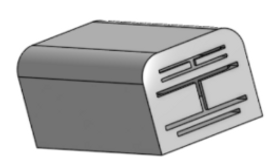
The objective was to design and prototype a wearable system capable of measuring head acceleration and impact severity while remaining discreet, lightweight, and fully compatible with standard rugby equipment. A key constraint of the project was that the device should not alter the player’s mobility, appearance, or match experience, ensuring acceptance by both athletes and coaching or medical staff.
From a technical standpoint, the solution relied on inertial sensing using multi-axis IMU sensors to capture both linear and rotational acceleration of the head during play. These measurements were processed locally by an embedded microcontroller, allowing rapid detection of significant impacts within a few milliseconds. Impact data, including acceleration magnitude and timing, could then be transmitted wirelessly via BLE or Wi-Fi to external devices for real-time monitoring by coaches or medical personnel.
Beyond sensing, the project also explored advanced concepts for dynamic protection. Several technologies were studied and benchmarked, including non-Newtonian fluids, layer-jamming structures, and fast electromechanical locking mechanisms. These approaches aimed to combine flexibility during normal movement with rapid stiffening under impact, highlighting future possibilities for intelligent cervical protection integrated directly into sports garments.
The development process followed a complete engineering workflow, starting from need analysis and state-of-the-art research, through design, CAD modeling, and physical prototyping. Multiple iterations were produced to improve ergonomics, sensor stability, robustness, and data reliability. Particular attention was paid to integration within textile and foam components commonly used in sports equipment, as well as resistance to sweat, shocks, and repeated use.
The final prototype demonstrated the feasibility of a compact, unobtrusive impact monitoring system suitable for real sporting conditions. While further refinements would be required for industrial deployment, the project successfully validated the core concepts of real-time head impact detection, wearable integration, and user-centered design. Overall, this project combined mechanical design, electronics, signal processing, and sports science, reflecting a multidisciplinary approach to a real-world engineering and safety challenge.


EVTOL PROJECT

This project was developed in partnership with Embraer as part of an academic–industrial collaboration focused on advanced air mobility and eVTOL aircraft. The main objective was to build and analyze a flight dynamics and control model of a multi-rotor eVTOL in Simulink, with a strong emphasis on low-speed flight regimes and vertical takeoff phases. The work was directly connected to Embraer’s EVE program and followed realistic engineering constraints inspired by industrial practice.
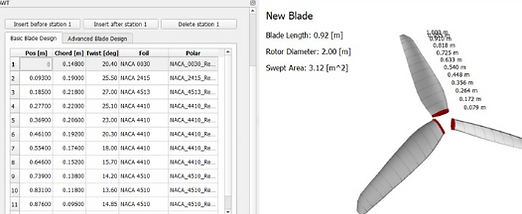
My personal contribution was concentrated on the aircraft modeling and control aspects. I was primarily responsible for developing the Simulink model, progressively integrating aerodynamic, mechanical, and control subsystems into a coherent flight dynamics framework. A key element of the project was the use of aerodynamic data derived from CFD studies to model forces such as thrust and drag, as well as rotor-generated moments. This approach enabled us to move beyond overly simplified assumptions and build a model that more accurately reflected the physical behavior of an actual eVTOL.
The modeling process followed a structured progression, starting from simple configurations and gradually increasing in complexity. Initial models focused on basic rotor thrust generation and vertical motion, and were then extended to multi-rotor architectures. Control laws were implemented and tuned to ensure stability and acceptable dynamic response, typically using cascaded control loops for position and velocity. This framework allowed us to assess how control performance evolved as aerodynamic fidelity and system inertia were introduced into the model.
A significant part of the project consisted of analyzing stability and controllability in low-speed and hover conditions, where most of the lift is generated by the rotors and classical fixed-wing assumptions no longer apply. The influence of parameters such as rotor speed, vehicle mass, aerodynamic coefficients, and configuration changes was systematically evaluated through time-domain simulations and scenario-based studies.
By the end of the project, the model had been refined both in terms of aerodynamic representation and control architecture, and the simulation campaign had been extended to a broader set of scenarios to evaluate performance and robustness. Overall, the project provided hands-on experience at the intersection of flight mechanics, aerodynamics, control engineering, and simulation, closely aligned with real challenges faced in modern aerospace development.


TELECOM PROJECT
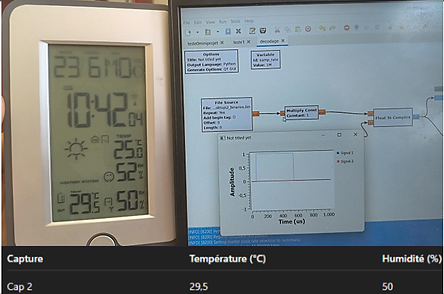
This project was carried out during the Telecommunications Systems course at École Centrale de Lille and focused on the reverse engineering of a real RF transmission system operating at 433 MHz. The objective was to analyze, understand, and reproduce the wireless communication between a commercial weather sensor and its display unit, which transmits temperature and humidity data over a proprietary radio protocol.
From a personal standpoint, this project was my first deep, hands-on exposure to RF protocol reverse engineering using both software-defined radio and signal processing tools. We worked with a Universal Software Radio Peripheral (USRP) in combination with GNU Radio to intercept and record the raw RF signals emitted by the weather sensor. The captured data was then analyzed offline to understand the signal structure, timing, and modulation scheme.
Through detailed signal analysis, we identified that the transmission used On-Off Keying (OOK) modulation, with a bit duration of approximately 0.5 ms, corresponding to 485 samples per bit. Using Python scripts, we extracted the binary frames from the raw I/Q data and decoded the structure of the protocol. This allowed us to clearly identify key fields such as the sensor ID, temperature values encoded in tenths of degrees, humidity, and control flags. The full logical frame consisted of repeated 36-bit packets, ensuring robustness against transmission errors.
Once the protocol was fully understood, we moved beyond passive analysis and actively reproduced the signal. By regenerating binary frames and re-modulating them using the same OOK scheme, we were able to transmit custom signals via the USRP that were correctly recognized by the original weather station display. This included sending modified temperature and humidity values, effectively emulating the original sensor without any access to its internal firmware or documentation.
This project was a very concrete introduction to real-world RF systems and highlighted the gap between theoretical digital communications and practical signal analysis. Working with GNU Radio, Python, and USRP hardware strengthened my understanding of modulation, sampling, filtering, and protocol design, while also developing practical debugging skills in noisy and constrained RF environments. Equally important, the project reinforced collaborative engineering practices, as successful decoding required coordinated experimentation, data sharing, and iterative validation within the team.


MUSICAL INSTRUMENT PROJECT
At the beginning of my double-degree program, I took part in a group project whose goal was to design and build an original musical instrument that could be played remotely. The project combined creativity and engineering, with the challenge of transforming digital user input into a physical and audible musical performance.
The final instrument took the form of a metallic “flower,” where each petal was made of a tuned metal tube corresponding to a musical note. The sound was produced through a mechanical striking mechanism: an electromagnet physically hit the metal tubes to generate the notes. An Arduino was used to control a servo motor that rotated the electromagnet, precisely positioning it in front of the correct tube based on the selected note.
A key aspect of the project was enabling remote interaction. Using a Raspberry Pi, we implemented a system that allowed users to input musical notes through a simple URL interface. When a user accessed the link and selected a note, the Raspberry Pi processed the request and communicated with the Arduino, which then actuated the servo motor and electromagnet to strike the appropriate tube. This architecture bridged web-based interaction and real-time physical actuation.
Throughout the project, I was involved in multiple stages of development, including acoustic simulations using CATIA to study resonance and sound properties, mechanical design and 3D printing of structural components, and embedded programming on both Arduino and Raspberry Pi platforms. This multidisciplinary workflow highlighted the importance of system integration, where mechanical design, electronics, and software had to work seamlessly together.
This project was particularly impactful for me because it merged artistic expression with technical problem-solving. It expanded my perspective on what engineering projects can be, showing how technology can be used not only for performance or efficiency, but also for creativity and user experience. Just as importantly, it reinforced the value of teamwork in complex, interdisciplinary projects.


ZENITH
During my undergraduate studies at the University of São Paulo, I took part in the Zenith extracurricular group, a student-led initiative focused on space-related projects such as sounding rockets, probes, and embedded systems for aerospace applications. Zenith was my first real exposure to the world of embedded systems, and it played an important role in shaping my early technical interests.
I joined the embedded software team, where I had my first hands-on experience with microcontrollers, particularly STM32 platforms. Until then, my background was mostly theoretical, and working within Zenith allowed me to understand how low-level software interacts directly with hardware, sensors, and physical constraints. It was an introduction to concepts such as peripheral configuration, serial communication, and real-time behavior, all in a very practical and collaborative environment.
In practice, I participated in a project called UARTZAP, which simulated a fictional space probe designed to explore a newly discovered planet. The idea was to build a modular embedded system capable of acquiring data from multiple onboard sensors, such as temperature, pressure, and humidity sensors, and transmitting this information through serial communication. Each subsystem was handled by different members of the team, mimicking the structure of a real aerospace project.
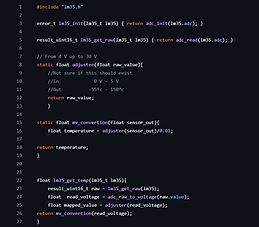
My specific responsibility within UARTZAP was the programming and integration of the LM35 temperature sensor. I worked on reading analog temperature data from the sensor, converting it into meaningful physical values, and preparing it for transmission within the system. While my knowledge of embedded systems at the time was still limited, this task gave me a concrete understanding of sensor interfacing, ADC usage, and the importance of calibration and validation in embedded applications.
Although I was very much at a beginner level, the experience was extremely valuable as a first contact with embedded systems. Zenith provided a motivating, hands-on learning environment, driven by passionate students and ambitious projects. The group fostered curiosity, teamwork, and experimentation, and it gave me an early glimpse into the challenges and excitement of building real systems that interact with the physical world.



PERSONAL PROGRAMMING PROJECTS
MY PARTICULAR INTEREST IN PROGRAMMING
I am particularly interested in programming because it naturally combines logical reasoning, structured problem-solving, and abstraction. As someone with an interdisciplinary profile, programming often acts as the common language connecting different fields such as mathematics, physics, data analysis, and engineering systems, allowing complex ideas to be modeled, tested, and validated efficiently.
I am proficient in C and C++, with a strong focus on object-oriented programming, and I regularly use Python for scripting, data processing, and visualization. Currently, I am expanding my skill set by studying SQL for data analysis and beginning my journey in Machine Learning and Artificial Intelligence. Both SQL and ML are being pursued through courses from the University of Michigan, with an emphasis on practical, application-oriented learning.
POLYGON ANALYZER

-
Developed primarily in C++ using object-oriented programming principles
-
Designed and implemented from scratch as a way to review and solidify C++ and OOP concepts
-
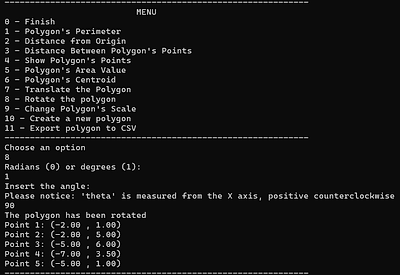
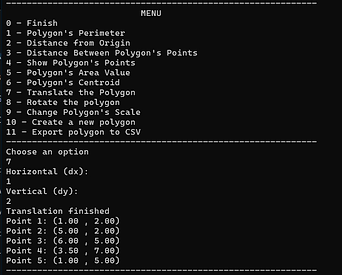
Allows users to create polygons by entering their vertices as coordinates
-
Computes geometric properties such as area, perimeter, centroid, and distances
-
Implements geometric transformations including translation, rotation, and scaling
-
Emphasizes clean class design, encapsulation, and modularity
-
Integrates with Python to visualize polygons graphically
-
Exports polygon data to .csv files, which are then read and plotted by a Python script

FULL VERSION IN:

MASS SPRING DAMPER SIMULATION

-
Fully developed in C++ with a strong object-oriented architecture
-
Combines programming with mathematical modeling and numerical methods
-
Allows the user to define a mass-spring-damper system from scratch, including mass, damping coefficient, spring constant, and intial conditions
-
Automatically computes key physical parameters such as damping ratio, natural frequency and overshoot
-
Simulates the dynamicresponse of the system over time
-
Offers a choice between numerical integration methods: semi-implicit Euler for speed and simplicity or RK4 for higher accuracy
-
Export time-series data to .csv files
-
Uses Python for post-processing and visualization of simulation results


FULL VERSION IN:

AVIATION SAFETY DATA ANALYSIS

-
Conducted a large-scale exploratory and temporal analysis of global aviation accidents using historical data from the Aviation Safety Network (ASN)
-
Fully implemented in Python, combining data cleaning, validation, statistical analysis, and visualization in a structured and reproducible workflow
-
Includes rigorous data preprocessing steps, such as duplicate removal, standardization of missing values, and consistency checks across temporal and categorical variables
-
Performs reliability checks to assess data completeness, detect outliers, and evaluate the validity of accident classifications over time
-
Analyzes long-term trends in accident counts, fatalities, and severity indicators across more than a century of aviation history
-
Introduces a custom severity index based on fatalities per accident, normalized to enable meaningful temporal comparisons
-
Investigates historical anomalies and structural breaks, including World War II and major security-related events
-
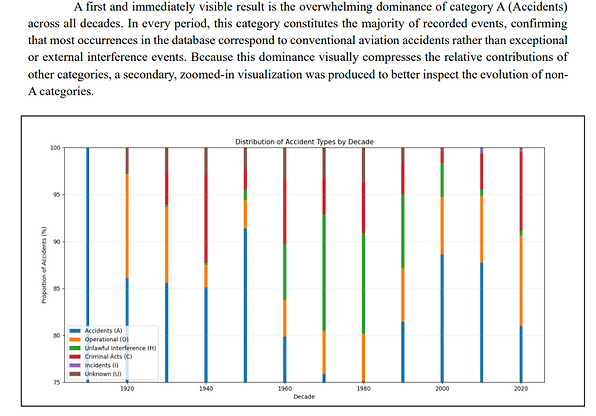
Studies the evolution of accident types by aggregating ASN categories and analyzing their proportional distribution by decade
-
Uses Python libraries such as Pandas, NumPy, and Matplotlib for data manipulation, numerical analysis, and visualization
-
Produces publication-ready plots and figures to support technical interpretation of aviation safety evolution over time


FULL VERSION IN:

WASTE TONNAGE SCENARIO PLANNING - MEL
-
Developed a category-level baseline forecasting + scenario planning tool to support operational decision-making for Métropole Européenne de Lille (MEL)
-
Built Business-As-Usual (BAU) projections by waste category and integrated a public policy target of –15% by 2030
-
Used interpretable regression baselines (Linear / Ridge / Lasso) trained per category, prioritizing clarity and decision support over black-box accuracy
-
Implemented strict time-aware validation (TimeSeriesSplit + walk-forward backtesting) and reported MAE/MAPE for realistic performance assessment
-
Transferred national trends to MEL scale via demographic normalization and explored population sensitivity to quantify planning risk
-
Generated prediction intervals using residual bootstrap to express uncertainty around long-horizon trajectories
-
Designed contrasted post-2030 scenarios (durable vs partially transitory policy effect) to frame uncertainty beyond the policy horizon
-
Highlighted hazardous waste (DDS) as a strategic signal despite lower volumes due to higher regulatory/safety/cost constraints
-
Ranked 3rd (Innovative Proposals) among 48 teams in the project challenge, recognized for the originality and practicality of our scenario recommendations


FULL VERSION IN:

FLIGHT DELAY PREDICTION WITH PRE-DEPARTURE DATA

-
Built a binary classifier to predict departure delays ≥ 15 minutes using only features available before takeoff (realistic operational constraint)
-
Prioritized recall as the primary metric (minimizing missed delays), complemented by Precision–Recall curve and Average Precision (AP) analysis
-
Implemented a clean preprocessing pipeline: parsing time features (HHMM → minutes), cleaning categories, deduplication, and label normalization (Y/N → 1/0)
-
Engineered robust pre-departure features: cyclic encodings for month/day-of-week, time-of-day bins, and log1p distance to stabilize heavy tails
-
Benchmarked multiple models (Logistic Regression, Random Forest, Gradient Boosting, HistGradientBoosting) under the same protocol
-
Tuned decision thresholds by scanning probabilities and selecting the best operating point under a recall constraint (deployment-oriented)
-
Concluded that performance is largely information-limited (feature signal is the bottleneck more than model capacity), guiding next steps for feature enrichment.


FULL VERSION IN:

REMAINING USEFUL LIFE (RUL) PREDICTION
NASA CMAPSS TURBOFAN ENGINES

-
Predicted Remaining Useful Life (RUL) from multivariate sensor data in the NASA CMAPSS turbofan degradation benchmark using a rigorous, engine-aware protocol
-
Modeled each engine as a temporal sequence of cycles and enforced train/validation splits by engine to prevent leakage across units
-
Established strong baselines with Linear/Ridge/Lasso, showing large gains over naive predictors while identifying clear linear saturation
-
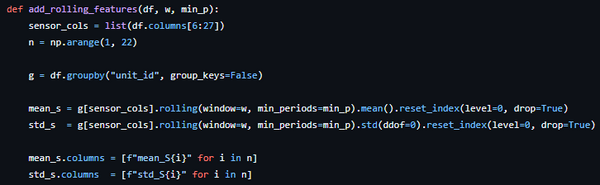
Introduced degradation memory through rolling feature engineering per engine (rolling mean, slope, and standard deviation)
-
Systematically compared non-linear models (Random Forest, ExtraTrees, HistGradientBoosting, XGBoost, LightGBM) with constrained hyperparameter search to limit overfitting
-
Evaluated using MAE in cycles, and performed final testing with one prediction per engine based on the last available cycle vs official CMAPSS targets
-
Emphasized methodological rigor (temporal handling + interpretability) and documented performance limits of tabular ML for degradation modeling

FULL VERSION IN:

ONLINE COURSES
As a Mechatronics Engineering student at the University of São Paulo, I have access to Coursera, a platform that offers academic courses across a wide range of fields from universities around the world.
I saw this as an opportunity to explore my curiosity for different areas of knowledge and to strengthen my multidisciplinary profile. Over time, I completed several courses in diverse subjects, with a particular focus on mathematics, machine learning, and data analysis. Among the institutions whose courses I followed are Imperial College London, Politecnico di Milano, and the University of Michigan.


COURSES TAKEN
-
Mathematics for Machine Learning Specialization - Imperial College London
-
Mathematics for Machine Learning: Linear Algebra
-
Mathematics for Machine Learning: Multivariate Calculus
-
Mathematics for Machine Learning: PCA
-
-
Machine Learning: An Overview - Politecnico di Milano
-
Applied Machine Learning in Python - University of Michigan
-
Unsupervised Algorithms in Machine Learning - University of Colorado Boulder
-
Deep Learning with PyTorch: Image Segmentation - Coursera
-
Database Design and Basic SQL in PostgreSQL - University of Michigan
-
Mastering Data Analysis in Excel - Duke University
-
Excel Power Tools for Data Analysis - Macquarie University
MY CERTIFICATES IN: